
Oversize Load Transport Services, Heavy Haul and Wide Load Shipping

Oversize load transport requires more than a truck and a flatbed. It requires permits in every state along the route, escort vehicles where regulations demand them, specialized trailer selection for the specific load dimensions and weight, and a logistics team that knows the rules in every jurisdiction the shipment passes through. Ready 2 Xecute provides oversize load transport and wide load shipping services nationwide, managing every element of the move from permit procurement through final delivery.
Whether you’re shipping construction equipment, industrial machinery, wind turbine components, agricultural equipment, or prefabricated structures, R2X matches your load with the right carrier, the right trailer, and the right route — and handles the permit and compliance process so you don’t have to.
What Is an Oversize Load?
An oversize load is any freight that exceeds the standard legal limits for width, height, length, or weight on public roads. Federal DOT standards define oversize as exceeding 8.5 feet in width, 13.5 feet in height, 53 feet in length, or 80,000 pounds gross vehicle weight — but individual states set their own thresholds and many are stricter than federal minimums.
A wide load specifically refers to freight exceeding the legal width limit of 8.5 feet. Over-dimensional freight typically describes loads exceeding multiple legal limits simultaneously. All three categories require special permits and, depending on dimensions and jurisdiction, escort vehicles, travel time restrictions, and route pre-approval.

Oversize Load Transport Services We Provide
Permit Procurement and Management
Every state along an oversize load route requires its own permit. R2X manages the complete permit application process — gathering load dimensions and weight specifications, filing applications with each state DOT office, coordinating multi-state permit timing so all approvals align before departure, and securing expedited processing where available. We handle permits for single-trip moves and annual permit programs for shippers with regular oversize lanes.Specialized Trailer Selection
The trailer determines the feasibility of the route and the safety of the move. R2X matches every load to the appropriate trailer type:- Flatbed trailers — 48 to 53 feet, up to 48,000 lbs, for standard oversize loads with secure chain-down or blocking requirements
- Step deck (drop deck) trailers — reduces overall height by 2–3 feet for taller cargo that would otherwise require height permits
- Removable gooseneck (RGN) trailers — detachable front for drive-on loading of self-propelled equipment, up to 150,000 lbs
- Double drop (lowboy) trailers — lowered center well for extra-tall cargo, maintains legal height on most routes
- Multi-axle heavy haul trailers — 6 to 20 axles for precise weight distribution on superloads exceeding bridge law thresholds
- Modular trailers — combined units for superloads exceeding 300,000 lbs requiring maximum flexibility
Escort Vehicle Coordination
Most states require pilot cars (escort vehicles) for loads exceeding 12 feet in width or 14 feet in height, though specific thresholds vary by jurisdiction. R2X coordinates front and rear escort vehicles as required by each state along the route, ensuring escort drivers are properly certified, equipped with required safety equipment (oversize load signs, amber lights, two-way radios), and positioned correctly throughout the move.Route Survey and Planning
Not every road can accommodate an oversize load. R2X conducts route analysis covering bridge height and weight clearances, road width and turning radius constraints at intersections and curves, utility line clearances requiring coordination with power companies, seasonal restrictions during harvest periods or holiday travel restrictions, and low-clearance structures requiring advance coordination or route modification.Nationwide and Cross-Border Heavy Haul
R2X provides oversize load transport across all 48 contiguous states, with cross-border capabilities into Canada and Mexico. International oversize transport requires additional documentation including customs forms, country-specific permits, and coordination with Roll-On/Roll-Off (RORO) or flat rack container shipping for overseas moves. Our network of over-dimensional carriers and logistics specialists handles the full complexity of cross-border and international heavy haul.
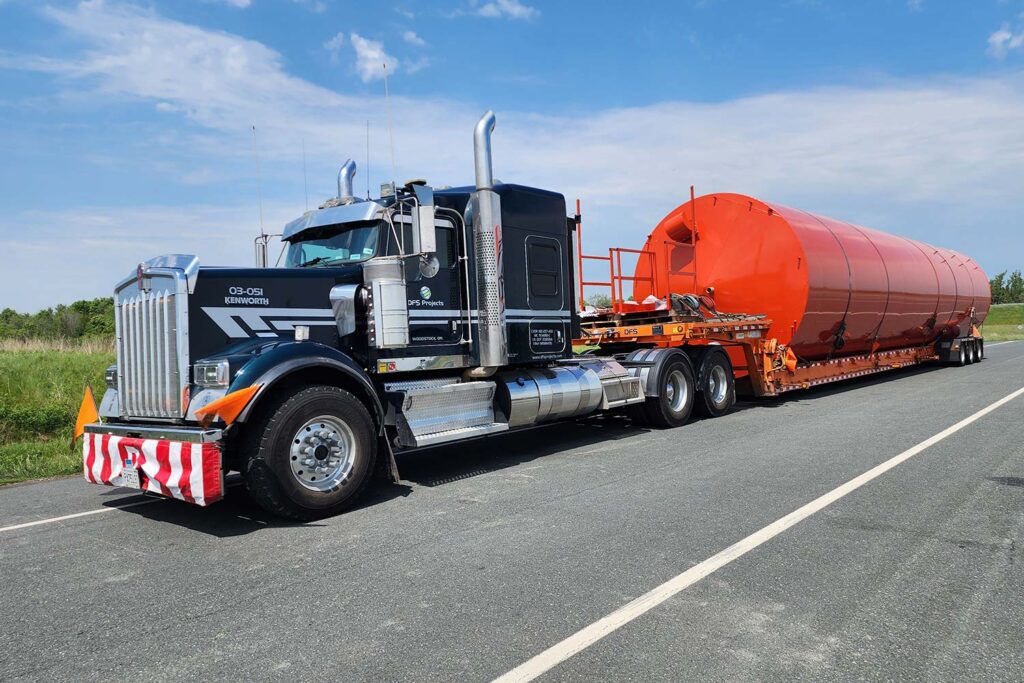
Types of Oversize Freight We Transport
- Construction equipment — excavators, bulldozers, motor graders, cranes, and road construction machinery
- Industrial machinery — generators, transformers, pressure vessels, processing equipment, and manufacturing units
- Agricultural equipment — combines, large tractors, irrigation pivots, and grain handling systems
- Wind energy components — turbine blades up to 200 feet, nacelles, tower sections, and foundation hardware
- Prefabricated structures — modular buildings, bridge beams, large structural steel assemblies
- Oil and gas equipment — drilling rigs, tanks, separators, and pipeline components
- Military and aerospace equipment — vehicles, aircraft components, and specialized cargo
Oversize Load Regulations and Compliance
The regulatory environment for oversize load transport is one of the most complex in freight. Federal DOT regulations establish baseline standards, but each state maintains its own rules for dimensional limits, permit requirements, travel time restrictions, and escort vehicle thresholds. Non-compliance carries serious consequences:
- Fines of $1,000 to $10,000 or more per violation, varying by state and severity
- Immediate vehicle impoundment and cargo detention until proper permits are obtained
- Driver citation and potential commercial driver’s license action
- Additional fines for each day of continued violation
R2X’s permit and compliance team tracks state-by-state requirements continuously, ensuring every oversize load move is properly authorized before departure. We carry knowledge of seasonal restrictions, weekend and holiday travel prohibitions, and state-specific escort requirements across all 48 states.
Why Choose R2X for Oversize Load Transport
Oversize load transport companies are not all equal. The difference between a smooth move and a costly compliance failure often comes down to permit expertise, carrier quality, and route planning thoroughness. R2X brings:
- A pre-vetted network of over-dimensional carriers with verified DOT authority, insurance, and equipment qualifications
- In-house permit management for all 48 states — no outsourcing to third-party permit services that add delay and cost
- 24/7 operations support throughout every oversize move
- Real-time load tracking with direct communication between driver, escort vehicles, and R2X operations team
- Experience across all major equipment categories and oversize freight types
- Competitive pricing with transparent cost breakdowns — permits, escorts, fuel surcharges, and equipment positioning fees itemized upfront
Frequently Asked Questions
What qualifies as an oversize load?
An oversize load is freight that exceeds federal or state legal limits for width (over 8.5 feet), height (over 13.5 feet), length (over 53 feet), or gross vehicle weight (over 80,000 lbs). Wide loads specifically exceed width limits. All oversize loads require special permits, and most require escort vehicles and travel time restrictions depending on dimensions and state regulations.
What permits are required for oversize load transport?
Every state along an oversize load route requires its own permit. Permits specify the authorized route, travel time restrictions, escort requirements, and load dimensions. Applications must be filed with each state’s DOT office, with processing times of 3 to 10 business days depending on the state. R2X manages the full multi-state permit application process for every oversize move.
How much does oversize load transport cost?
Oversize load transport pricing depends on load dimensions and weight, distance, number of states crossed (permit costs per state), escort vehicle requirements, specialized trailer type, and fuel surcharges. Base rates typically range from $2 to $5 per mile for standard oversize loads, with permits adding $50 to $500 per state and escort vehicles adding $150 to $300 per day. R2X provides detailed, itemized quotes with no hidden fees.
What types of trailers are used for oversize loads?
Common trailer types for oversize loads include flatbeds (standard oversize up to 48,000 lbs), step decks or drop decks (for taller cargo), removable gooseneck (RGN) trailers (for self-propelled equipment up to 150,000 lbs), lowboy or double drop trailers (for extra-tall cargo), and multi-axle heavy haul trailers (for superloads requiring precise weight distribution).
When are pilot cars required for oversize loads?
Pilot car requirements vary by state, but most states require escort vehicles for loads exceeding 12 feet in width or 14 feet in height. Some states mandate escorts for any load exceeding maximum legal width regardless of other dimensions. Both front and rear escorts may be required for the widest or tallest loads. R2X coordinates all escort vehicles as required by each state along the route.
What are travel time restrictions for oversize loads?
Most states restrict oversize load travel to daylight hours, typically one half hour before sunrise to one half hour after sunset. Many states prohibit oversize travel on weekends, holidays, and during certain weather conditions. Some states require additional restrictions for superloads or loads on high-traffic corridors. R2X’s route planning accounts for all travel time restrictions in every state along the move.
Can R2X transport oversize loads across multiple states?
Yes. R2X provides oversize load transport across all 48 contiguous states, managing permits in every state along the route simultaneously. Multi-state coordination is one of the most complex aspects of oversize shipping — permit timing must be aligned so all approvals are in place before departure and for the full duration of the move. R2X handles this process entirely.
What is the difference between an oversize load and a superload?
An oversize load exceeds standard legal limits but can be transported with standard oversize permits. A superload exceeds higher thresholds — typically over 16 feet wide, 16 feet tall, or 200,000 lbs — requiring engineering analysis, special permits from state highway departments, and often route surveys and bridge load calculations. R2X handles both oversize and superload transport.